Showing posts with label language. Show all posts

Wednesday, May 13, 2020

Peace in Europe

How I would like to see VE Day renamed "Peace in Europe Day"! There is too much of the "Two world wars and one World Cup" baggage attached to it, especially in the still too obvious brevity undercurrents. Maybe I'm just too sensitive, but...

So as a small gesture to myself and others who share my views, I posted on Facebook asking for "75 years of Peace in Europe" in as many languages as possible. 

Here is the result:

75 años de paz en Europa (Spanish)
75 de ani de pace în Europa (Romanian)
75 anni di pace in Europa (Italian))
75 ans de paix en Europe  (French)
pax in Europa (pacem Europa). (Latin
Taika Europoje  (Lithuanian) 

75 години мир в Европа  (75 rodini mir a Europa)
(Bulgarian)
Mír v Evropě (Czech)
Mir u Europi!   (Croatian)
75 лет мира в Европе (75 let mira a Europe)
(Russian)

75 lat pokoju w Europie (-Polish)
Pokój w Europie. (Polish)

75 Jahre Frieden in Europa
75 års fred i Europa. (Danish )
75 års fred i Europa (Swedish) 
75 jaar vrede in Europa - Dutch


75 bliain de Shíocháin san Eoraip ( ☘️Irish)
70 bledhen a gres yn Europa  (Cornish)
75 mlynedd o heddwch yn Ewrop
Welsh 

ħamsa u sebgħajn sena ta paci fl'europa (?Maltese)

 سنة. السلام في أوروبا (Arabic) 
75 san. alsalam fi 'uwrubba.  (Arabic)

75 שנות שלום באירופה 
Hebrew
(75 shanat shalom be’europa)

We have Greek as well.

Thursday, July 27, 2017

More Polish


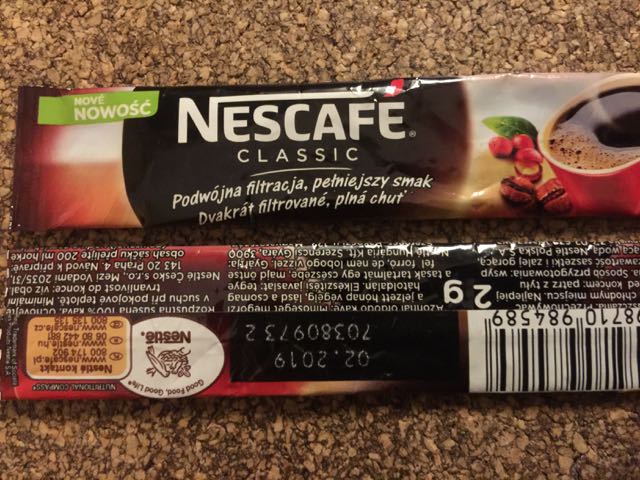
Don't tell me - this is getting beyond silly, but it's better than keeping all the food wrappings.

...goraca, ale nie wrzaca woda ...hot but not boiling water . . . 

Sunday, July 23, 2017

Learning Polish

Today someone had left a shopping list on a scrap of paper in a trolley. Out of curiosity, I looked at it - it's in Polish.

Now to work out what they were buying. But the problem is that I can't quite decipher the writing, not even close enough to look the words up!

Maybe the fourth one down is ziemniacki - potatoes?  Otherwise, I'm all at sea.

Saturday, July 15, 2017

Learning Polish

Begun as a challenge - not a Romance or Germanic language, and with grammatical complications.
After six months or so it lookes considerably less alien, and we managed to use a little during a nine day long trip to Warsaw and Krakow. 
As always, even supermarket bags provide endless opportunities to extend the vocab.

"Lovely to see you!"

"Shop at Carrefour.
I care about nature"

"We reduce energy consumption"

"For love of the environment/ in love with the environment".

A waitress wrote this on our bill. We dropped in for coffee and cake after visiting the museum in the Schindler factory.


Wednesday, September 21, 2016

A fabulous month

Fabulous - not in the sense that it was nothing but a story, a dream . . . but we both thoroughly enjoyed discovering something of South America, and Chile in particular. in spite of its troubled past, the people are friendly and helpful, the scenery is spectacular, and the view of the night sky and the Milky Way in the Atacama is out of this world!  Plus i had lots of chance to practise my Spanish.

We returned a week ago,  and the glow has not yet faded. I may copy some of my poedoodles and sketches to this blog, but otherwise some sketches are here and some words are here. And there's also Harry's lively blog which he kept while we were there.


Thursday, August 01, 2013

Why do I walk so much?


Is it the nearest thing I can find to meditation, or my way of paying my dues to my inner nomad?  Is it for the exercise that’s in it?  Or for the easy companionship when I walk with others?  There are elements of all of these, but it comes down to the fact that I love it.  The reasons don’t matter.  It’s the time I feel most myself, most at peace, and most interested in life. When I’ve been walking I can enjoy other activities even more.
Walking in remote countryside clears my brain. Walking in cities may lead to odd encounters and discoveries.  It makes little difference if it’s somewhere I know well, or somewhere new.  Though if I had to choose I would probably go with the new. Like Baudelaire in his poem Le voyage and like many people – novelty enchants me.
But this search for something new mustn’t be too superficial – and walking gives me the chance to feel I belong to a place, and to lay hold and possess it in return.  I think it’s on the same level as learning a language, which is a way of understanding a country and feeling at home there.
I tend not to philosophise about this in my walking blog, but I have certainly put some miles under my boots this year.

Wednesday, June 12, 2013

Les Mécènes

Patrons or sponsors -named after a certain Gaius Cilnius Maecenas, an ally, friend and advisor to Octavian, and patron of poets.

Seen in the Louvre at the top of lists of sponsors or patrons. 

Tuesday, May 14, 2013

Epic fail 9/10

Ye gods and minnows! 
I decided to take the grammar test on the BBC's website.  Sailed through with 9/10.  ONLY 9!
The question that flummoxed me was Q3.

Read this sentence carefully. "I'd like to introduce you to my sister Clara, who lives in Madrid, to Benedict, my brother who doesn't, and to my only other sibling, Hilary." Which of the following is correct? 

1. Hilary is male

2. Hilary is female

3. It's impossible to know from the context

I chose number 3.

WRONG! He's male. The absence of a comma before "who doesn't", implies that there are other brothers. A comma after "my brother" would mean that there was only one brother.

It seems my formal grammar education, from 1957-8 has let me down.
Well, this is such a tiny difference that I think it would go unnoticed by most people.  Is it important?  The sentence reads as though it has been contrived. Wouldn't most us refer to a brother as a brother, not as a sibling? And isn't the sentence far more likely to be used in speech? We rarely hear punctuation in speech.
The sentence has been deliberately constructed to catch people out.  Oh yes, it succeeded in that.  And I'll probably remember the answer from now on. If I ever need to.

Friday, May 10, 2013

Grammar again -

Food for thought in this article in the Guardian by Thomas Jones, the editor of the London Review of Books blog.

Jones hangs the article on the Bad Grammar award given by Toby Young and two other judges to the letter sent to Michael Gove by 100 "bad academics".  Toby Young claims that the letter is so bad that it makes the case for rigid teaching of grammatical 'rules'.  Jones reckons the award has more to do with politics than grammar.

Jones quotes from Steven Pinker's book The Language Instinct.
"Since prescriptive rules are so psychologically unnatural that only those with access to the right schooling can abide by them, they serve as shibboleths, differentiating the elite from the rabble." 

He goes on to examine several "rules" - some of which are mere conventions, some of which are in the process of changing, and some of which are worth following because they lead to more elegant, clearer writing.

I shall remember Pinker's quote - or the gist of it.  Spot on, I think.


Another article worth reading, by David Crystal

Tuesday, May 07, 2013

Language super-family

Interesting article - note to self.  Some common roots to words in Asian and European languages.


Writing in Proceedings of the National Academy of Sciences, the authors list 23 words found in at least four of the proposed Eurasiatic languages. Most of the words are frequently used ones, such as the pronouns for "I" and "we", and the nouns, "man" and "mother". But the survival of other terms was more baffling. The verb "to spit", and the nouns "bark" and "worm" all had lengthy histories.
"Bark was really important to early people," said Pagel. "They used it as insulation, to start fires, and they made fibres from it. But I couldn't say I expected "to spit" to be there. I have no idea why. I have to throw my hands up."
Only a handful of verbs appear on the list, but Pagel points out "to give", which appeared in similar form in five of the Eurasiatic languages. "This is what marks out human society, this hyper-co-operation that we do," he said.
From their findings, the scientists drew up a family tree of the seven languages. All emerged from a common tongue around 15,000 years ago, and split off into separate languages over the next 5,000 years.
From the article.

Wednesday, March 06, 2013

Random thoughts on -ees from the pensive pedant


I’m gradually becoming a non-pedant on grammar and spellings, but some things grate.

When did we stop doing things like retiring or attending?  Surely some who does things is an –er, not an –ee?

So you love – you are a lover.  I drive – I am a driver.  I employ – I am an employer.  

I am employed – I am an employee.

So why, if you attend a fashion show, have you suddenly become an “attendee”?
“a bottle of which was handed to each show attendee . . .”
(from Guardian 06.03.2013)
It sounds no more elegant to me than an attender – and sounds as though you’ve been attended. Why not avoid the issue and hand a bottle to everyone who attended?

Then pensioners, or people who have retired, are referred to as retirees, as though they’ve all been retired against their will. 

Is this all a plot to normalise passivity?  (Not a serious question - yet.)

Thursday, January 24, 2013

Grammaire, grand'mère?

Oh woe is me, for I shall soon be undone!  I have begun to snap at grammar pedants when in fairness I used to be one myself.  Why do some people think that sloppiness in grammar, or rather the use in writing of expressions which are common in speech, shows that ones ideas are fundamentally flawed?

I'm all for clarity and elegance, and the removal of ambiguity, unless it serves a purpose, as it may do in imaginative writing, but I'm not going to get my knickers in a twist if someone says "Me and my beloved cat" instead of "My beloved cat and I".  I cringe more at the over-correct incorrect grammar of "He saw John and I", but even that gram-crime can be forgiven so long as I understand the content.

I believe that grammatical "rules" are based on usage, and usage is clearly changing. Different languages have different rules.  "My husband and I" - English.   "Mon mari et moi" - French.
Usage, habit, what people say. What's easier to say. What's clear and simple. Not rigid rules of subject and object.  And yes, English is changing.  "Me and my husband" is commonplace - not to be confused with common and vulgar.

Language has evolved, is evolving, and will continue to do so. Have we reached such perfection that we should preserve ourselves in aspic?

Or is it more the attitude of those pedants who sneer that gets right up my nose?

Although - I would love to be able to discreetly correct (split infinitive, see what I did there?) those who write "your mad!"  "your brilliant!" " your doing ok".   But their (ha ha ha) not incomprehensible,  are they?


Something that possibly touches on this obliquely.

Friday, June 08, 2012

a pedant repents


Hahaha ‘I seen’ -
how stoopid can they be?
Don't they know the rule?
Language in formaldehyde
is halfway dead already.

Tuesday, February 28, 2012

La Fontaine - Le Corbeau

        LE CORBEAU ET LE RENARD
       Maître Corbeau, sur un arbre perché,
           Tenait en son bec un fromage.
       Maître Renard, par l'odeur alléché,
           Lui tint à peu près ce langage :
       Et bonjour, Monsieur du Corbeau,
    Que vous êtes joli ! que vous me semblez beau !
           Sans mentir, si votre ramage
           Se rapporte à votre plumage,
     Vous êtes le Phénix des hôtes de ces bois.

À ces mots le Corbeau ne se sent pas de joie,
           Et pour montrer sa belle voix,
   Il ouvre un large bec, laisse tomber sa proie.
   Le Renard s'en saisit, et dit : Mon bon Monsieur,
              Apprenez que tout flatteur
     Vit aux dépens de celui qui l'écoute.
   Cette leçon vaut bien un fromage sans doute.
           Le Corbeau honteux et confus
   Jura, mais un peu tard, qu'on ne l'y prendrait plus.

Tuesday, December 13, 2011

A link to synch with idiosyncracy

Too good to  miss - too long to copy - click on title or click here  - the vagaries of English orthographical diversity.

Sunday, November 27, 2011

An anecdote about translation

Confession time - I haven't yet read the article, but I couldn't resist passing on this little story from the comments beneath it.  I don't care if it's true or not, and I'm sure there are just as many rushed and stressed Irish and Spanish people as there are laid-back English and Americans:

The Irish poet Patrick Kavanagh, and a Spanish professor were on the radio  discussing translation.  In order to illustrate his point about translations  failing to carry  the finer nuances of words,  the Spanish professor asked,

"For instance, in Irish, is there any word which means the same as "mañana"?


"Indeed," replied Kavanagh,"we have several words in Irish that mean the same as "mañana". None of them, however, carry quite the same sense of urgency!"

Thursday, July 21, 2011

Esperanto -

After talk about Harry's grandparents being in Paris for the conference in 1914 we have found quite a lot of postcards in Esperanto including the official one. The conference was curtailed and the delegates sent home as war was about to break out.


to be completed.

Saturday, April 11, 2009

Words and changing usage

Words are my tools ( was - My tools are words, )
and love them as I may,
the common herd makes use of them,
misuses, I might say,
were I inclined to pedantry.
‘You are’ I hear the call.
These tools you hone and store
are not locked up from pilferers
but lie in sight of all.
They die without the light
unpolished, lacking shine.
The trains of thought must run and run,
or rails, long since disused,
will dull and fade to history,
like Concorde, paper aeroplane
that’s banished from the skies
mere symbol of our past delights
profligate supersonic flights.
But words, just words is all they are,
these tools inside my kit
and if abused and then refused
they’ll wither on the line.

This came from two things. I saw the word 'illusive'. I thought it was made up, a mis-spelling of 'elusive'. But no, it exists, meaning 'illusory'. Though it was used as though it meant 'elusive'. The shifting sands of semantics caught at the moment when meaning slipped through my fingers.

Then there was a 'prompt' - paper aeroplane.

Wednesday, January 09, 2008

Least worst

It's everywhere. It bugs me like crazy. It can't be correct, can it? What does it say that 'least bad' doesn't?
It's two superlatives together - least + most bad.
I hate it!
Especially in written language - in an article by one of the Guardian's journalists.

However, now I've had my rant, I expect I shall have to accept it as a convenient shorthand idiom meaning 'the best of a bad bunch'. Language changes all the time, and not always grammatically.

Thursday, January 03, 2008

Frivolity and intellectual rigour?

For some reason this morning I am in a frivolous mood. Maybe because I've scrubbed the kitchen floor and feel in need of a reward. So I have wavered between online banter, playing Scrabble, and investigating concepts like 'fourth person plural' , which really exists as a concept in the Algonquian languages, spoken by some native North American peoples.
Didn't I say I'd stop procrastinating tomorrow?