Wednesday, October 05, 2016

Our trip to Chile - some of the people

I've blogged a few experiences on the walking blog.

One of the many aspects I enjoyed about our trip was the people we met, and talked to in Spanish or English.

Firstly, on the plane a very pleasant couple who I spoke to as we were nearing Santiago. I wanted to know when we would see the Andes - we didn't want to be on the wrong side of the plane.  They found this amusing - in any case the plane will turn so that you're on the best side, they told me. Quite right too, and, you know what, the Andes are pretty well visible from almost everywhere in Chile . . . but we did get a great view of the dawn light on the mountains.


In the lift from the appartment in Santiago we met a New Zealander. He was certainly in his sixties, and travelling round parts of South America on his own, hiring motorbikes. He'd  spent some time in the deserts of Bolivia and Peru, and was about to head towards Valparaiso when we spoke to him.

On the second or third day we were there we were walking through the Parque Forestal, a lovely avenue of trees with play areas and walkways, which goes through the town parallel to the River Mapocho. The river itself is not very attractive, enclosed by concrete as it rushes its way through the city. Five young women stopped us, and asked if they might interview us, about ourselves, our impressions of Chile and Santiago, and also about involvement in the community and leadership. Most of this I managed in Spanish. For once, I asked to take a photograph of them as a souvenir.  I tried to keep up the habit!


The next long chat was with the lady in the Café del Pintor in Valparaíso, where we ate twice during the four days we were there. The food was delicious, and reasonably priced, and the restaurant was not busy at the time we were there. She took a photo of us and was happy to chat about the food, Chile in general, and what to see in Valparaiso, as well as being interested in what we were doing, where we were going and so on. 

At the end of our stay in Valparaiso we caught the early morning bus back to Santiago, and then a plane to Calama, a mining city in the Atacama desert. From there we travelled by car to Coyo, a small settlement near San Pedro de Atacama. A harsh, dry climate, with hot days and cold nights. We stayed in a house made of adobe, but tiled and provided with all mod cons, even if they didn't always work, or were subject to power cuts. The internet stayed on, and was excellent at all times!
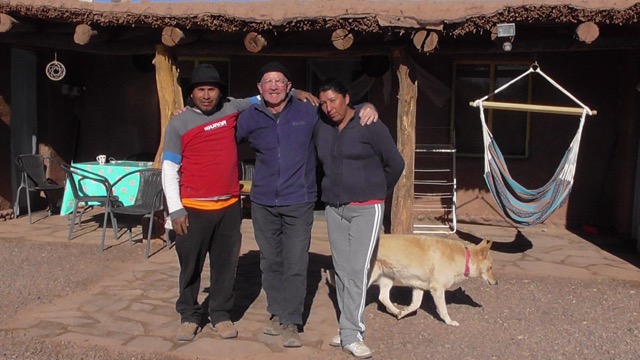
Jany and husband, and their friendly dog


The family who looked after the house in the owner's absence were local people, living in a house without electricity, as we discovered when we phoned them to ask if theirs was on. They must have thought we were real first world wimps. We eventually had a long conversation with Jany on the day we were leaving. She was very knowledgeable about the history of the area, and the animals and plants and their uses. Her daughter would like to study art, but can't afford the fees.

In the Valle de la Luna we met a man from Leeds - he'd been to Bolivia and Peru as well, and had hired a bike to explore the valley. We saw him again as we scrambled up a rather uneven hillside to catch a good view of the local volcano - Licancabur.
There's no photo of him, but he did take one of us.
  
Later on that day, on top of the Duna Mayor, a lively Chilean family from Santiago were taking selfies, so I offered to take a photo of them. They proved to be very friendly - the father spoke good English too. The children were having fun taking silly videos of their dad. We all stayed on the Dune to watch the spectacular sunset colours.

We had to return the car to the airport in Calama, and ended up in the middle of Calama, unable to find any roadsigns to it. The first guy we asked seemed to find it incredible and actually quite funny, but was not a lot of use! But we did ask a woman, who was picking her daughter up from school. She was very helpful, and even drew a map for us.
We arrived in plenty of time to return the vehicle and catch our flight! 


A chance meeting in a restaurant in La Serena with two young women enlivened our evening. One of them spoke good English and said she would love to be an English teacher, but can't afford the fees. 


Finally, in Vicuña, a small town in the Elqui valley we stayed at the Solar de los Madariaga, a nineteenth century house built by the wealthy great grand-father of the present owner, Mitzi Sylvia Diaz Cortes. Harry gave the Mitzi and her husband Alberto a watercolour sketch of their garden before we left.

There were many more - almost everyone we spoke to, asking the way, or for some kind of information was friendly, patient and helpful.    In spite of the warnings about looking like tourists, not carrying valuables around, especially in a backpack, and not venturing into certain areas - we had no bad experiences. We did manage to lose three hats between us, and on one occasion I thought I'd lost my purse, but it was back at base.


Wednesday, September 21, 2016

A fabulous month

Fabulous - not in the sense that it was nothing but a story, a dream . . . but we both thoroughly enjoyed discovering something of South America, and Chile in particular. in spite of its troubled past, the people are friendly and helpful, the scenery is spectacular, and the view of the night sky and the Milky Way in the Atacama is out of this world!  Plus i had lots of chance to practise my Spanish.

We returned a week ago,  and the glow has not yet faded. I may copy some of my poedoodles and sketches to this blog, but otherwise some sketches are here and some words are here. And there's also Harry's lively blog which he kept while we were there.


Thursday, August 04, 2016

The Scottish play with added atmosphere

The wind has been strengthening all day, noticeable on the motorway drive, and more so as we picnic on the stately 'picnic slope' at  Tolethorpe Hall before the play.

We follow the sun, minor heliotropes, shifting our chairs, balancing our plates. We are not of those who dine on weighted down but flapping tablecloths.


"This evening's performance will begin in five minutes."

We take our seats and watch the branches dancing , and hear the leaves whooshing or soughing.  Better than a painted backcloth and a worthy background for the initial meeting of the weird sisters, and the general mood of the play.

Another thoroughly enjoyable production by the Stamford Shakespeare Company, with particularly strong performances in the roles of Macbeth and Lady Macbeth.

Friday, July 22, 2016

A day at the seaside

an early start to drive east to the coast
the sun already high at seven
by eight outside Peterborough 
the rush hour is half-hearted
by nine we see the sea

Hunstanton's car parks offer loads of space
the sun shines hot, but coffee hits the spot
the tide is out, the beaches spread for miles
we stroll along the prom  
bathed by a sea breeze

the cliffs rise in broad colour bands
the greens and gardens lead upwards
to the bowling club and cafe with a view
benches along a wall, almost in shade

we walk, we look for hats and sandals
have lunch and wander to the beach
the tide's way way out, 
a long hike to the sea
we sport the trousers-rolled-to-paddle look

retreat with chairs and books to wait awhile
watching the crowds, all ages, sizes
by five the sea is close and deep enough to swim
and warm, no shivers today
though we have memories

two years since we've had a sea swim
this time no need to brace as 
the water licks my belly

when we emerge the breeze is welcome
not fierce and chill

a meal at Goblin Pantry fills the belly
we still seek shade and breeze

To end the day a pilgrimage to holdays past
we visit Heacham, locate the house called Shenstone

drive to the beach and watch the sun go down
from this westward facing beach in Eastern England
its golden orange red path on the waves
silhouettes walkers, a dog, an evening bather.

Turning round, we see the risen moon is full.

Tuesday, July 12, 2016

Day out at Clumber Park

We met Dan, with Isaac and Rose, for a day at Clumber Park, in Nottinghamshire. The drive up was one of the wettest ever, torrential rain and loads of surface water on the A1. The Park is a huge estate owned by the National Trust, and was once the seat of the Dukes of Newcastle.
A mansion stood near the lake, and this year there is a series of outdoor "rooms" on the site. 

Antlers and a moustache and picture frames in one room, dining furniture, which serves as picnic tables, sofas and armchairs, 
a free-standing freplace and a front door!  Scope for silly games and role plays.  
The mansion was demolished in the 1930s. 


The Park has loads of space to walk or cycle, as well as the lake and the longest double avenue of lime trees (tilia) in Europe.
The church of St Mary the Virgin is a rather blocky Gothic Revival chapel, dating from 1886.  Interior of Red Runcorn stone, exterior Steetly ashlar with Red Runcorn dressings. I had to look that up!  We took the opportunity to sketch the church after Dan had left, giving ourselves half an hour.
As I was packing up, these greylag geese thought the carrier bag must contain food. Sorry, guys, nothing doing.


Footnote: We were last here in June 2012. Four years pass in a flash.


Friday, July 08, 2016

Travels with a Donkey in the Cévennes

From one book to another and another leads the trail.

After reading James Hogg's The Private Memoirs and Confessions of a Justified Sinner, I had already put Dr Jekyll and Mr Hyde on my mental re-reading list.
Then a friend posted a link to a programme about Robert Louis Stevenson, and Travels with a Donkey in the Cévennes. 


As an inveterate walker, though never with a donkey, and not for many years with camping gear or anything like, I had to read it again.  Sometimes he slept in inns, often sharing a room with others, sometimes he camped out under the stars. The book is a great mix of descriptions of scenery, reflections on the people he met, his own thoughts and feelings and the history of the region.  
The Cévennes area was the site of religious conflict between Protestant Camisards and Catholics at the beginning of the eighteenth century, and Stevenson met people from both faiths, leading him to make comparisons with the Covenanters in Scotland. 
And it leads me to reflect on the way religious differences divide communities and people even now.
But the lasting impression is of his appetite for adventure and discovery.
So onwards to Dr Jekyll and Mr Hyde. . . 

Wednesday, June 22, 2016

The View from Castle Rock, by Alice Munro

I was surprised and intrigued to discover that Alice Munro, the Canadian short story writer and Nobel prize winner had connections with James Hogg and the Ettrick Valley.
I read and enjoyed some of her work several years ago.  

Her writing has an understated precision, the stories set in rural and small town Canada, mostly in the mid-twentieth century.

The View from Castle Rock takes its title from the story that one of Munro's ancestors, James Laidlaw, pointed out to his son, Andrew, the Kingdom of Fife on the far side of the Forth, declaring that it was America.  An example of the Laidlaw love of stories, which runs through the generations from at least the time of Will o'Phaup, the last man in Scotland to speak with the fairies.

I was warned that Munro was not very flattering about the Ettrick valley - and indeed she is not, though her first visit involved walking around the graveyard in the rain, not the best way to see a place and very different from our first visit in glorious summer weather.

Ettrick church on a gloomy morning


Of course, I was fascinated, as I usually am, by the mention of places I had seen, near to the cottage where we were staying, and the way the history of the Laidlaws is woven into the fabric of the valley. Much of Munro's material here comes from Hogg's writings, in the Shepherd's Calendar in Blackwoods Magazine, brought back to life with her usual deft touch.

When it came to her ancestors' journey over the Atlantic and their first years in Canada, the book continued to hold my interest. She adds her imagination to the bare bones of a factual account, helped by the fact that "...every generation of our family seemed to produce somebody who went in for writing long, outspoken, sometimes outrageous letters, and detailed recollections."  She was lucky to have the material, but the treatment of it is very much her own, wonderful storyteller that she is.

I think anyone who has been caught up in an obsession with family history will recognise this sentence in her epilogue.
"We can't resist this rifling around in the past, sifting the untrustworthy evidence, linking stray names and questionable dates and anecdotes together, hanging on to threads, insisting on being joined to dead people and therefore to life."


Sunday, June 19, 2016

The Ettrick Shepherd, James Hogg

We recently spent a week in the Ettrick Valley, and became interested in James Hogg through an exhibition in the old primary school.
I have also written a couple of short posts about some of his work. There is plenty of info available online too.


James Hogg was born in the Ettrick Valley, late in 1770. His father was a tenant farmer at Ettrick Hall, and his mother Margaret Laidlaw was the daughter of Will o'Phaup, reputed to be the last man in the Borders to talk with the fairies. His mother knew lots of traditional local songs and stories.
James left school after six months and went to work as a cowherd to help the family finances.  In his teens taught himself to read and write, and play the fiddle. He began to write poems and songs.
Around 1800, while he was working as a shepherd, he met Walter Scott, who was Sheriff of Selkirk, and was collecting material for his Border Ballads. The two men became and remained friends.
Tibbie Shiel's Inn, visited by James Hogg and Walter Scott

Hogg moved to Edinburgh in 1810, as he was unsuccessful as a farmer.  He didn't make a lot of money from his writing, but began to make a name for himself.
In 1815 the Duke of Buccleuch granted him, rent-free, the farm of Altrive in the Yarrow valley.
His most famous work,  The Private Memoirs and Confessions of a Justified Sinner, was published in 1824.
James Hogg died in November1835, and is buried in Ettrick churchyard, near his parents and Will o' Phaup.

James Hogg's tombstone

Tombstone of William Laidlaw (Will o'Phaup), and of his daughter, Margaret Laidlaw Hogg, and her husband, Robert Hogg. Robert and Margaret were the parents of James.

Alice Munro, the Canadian short story writer and Nobel Prize winner, was a Laidlaw before her first marriage. She descends from James Laidlaw, a cousin of James Hogg, and from Will o'Phaup.
She tells the story of this in her 2006 book, The View from Castle Rock. Thanks to her book, I was able to find and decipher the gravestones - and James Hogg's epitaph for Will o'Phaup.

Here lyeth William Laidlaw
the far famed Will o'Phaup,
who for feats of frolic, agility and strength,
had no equal in his day . . .


Thursday, June 16, 2016

The Private Memoirs and Confessions of a Justified Sinner

James Hogg's most famous book, published in 1824, was rediscovered and praised by André Gide, and influenced Stevenson's Dr Jekyll and Mr Hyde. Ian Rankin has also praised it highly.
I decided I should read it, and found it surprisingly easy in spite of occasional bursts of Scots speech.

It contains comedy alongside horror.  There are echoes of the conflict between episcopalians and presbyterians. There's plenty of criticism of the Calvinist doctrine of predestination - giving the chosen ones a free pass to heaven.  There's a shape-shifting demon, and undertones of Faust. 

His examination of fanaticism, and the way it leads people to believe they are justified in killing those who disagree with them resonates strongly today.


Monday, June 13, 2016

A boy's song by James Hogg, the Ettrick Shepherd (1770-1835)

A boy's song

Where the pools are bright and deep,

Where the gray trout lies asleep,

Up the river and o'er the lea,

That's the way for Billy and me.


Where the blackbird sings the latest,

Where the hawthorn blooms the sweetest,

Where the nestlings chirp and flee,

That's the way for Billy and me.


Where the mowers mow the cleanest,

Where the hay lies thick and greenest,

There to trace the homeward bee,

That's the way for Billy and me.


Where the hazel bank is steepest,

Where the shadow falls the deepest,

Where the clustering nuts fall free.

That's the way for Billy and me.


Why the boys should drive away,

Little sweet maidens from the play,

Or love to banter and fight so well,

That's the thing I never could tell.


But this I know, I love to play,

Through the meadow, among the hay;

Up the water and o'er the lea,

That's the way for Billy and me.


JAMES HOGG.

Wednesday, March 30, 2016

Teigh and its church

Another in my occasional series of interesting churches.

This one is near Oakham, and a church I've intended to visit since walking the Rutland Round in 2012.
From the outside it doesn't look special, but its interior is light and welcoming, and today was filled with the scent of fresh daffodils.

The base of the tower is all that remains of the original 12th or 13th century building. The present church was built in 1782 by the rector, Robert Sherard, Earl of Harborough. The style is "Strawberry Hill Gothic", and the pews face inwards.
Looking toward the pulpit, with the trompe l'oeil window.
toward the altar at the other end of the church.

The two fonts - the smaller one was originally attached to the altar rail. The stone one was carved by a former rector, Anthony Singleton Atcheson.

Teigh is one of the "thankful villages", where all those who served in World War I returned home.

Notable rectors of Teigh

1321 Richard de Folville joined outlawed relations in robbery and murder. He was overpowered by the under-sheriff and his men in Teigh church in 1341, and beheaded in the village street.

1604 Zacharias Jenkinson, a Puritan, refused to bow at the name of Jesus, or stand at the Gospel.

1782 Robert Sherard, later Earl of Harborough, rebuilt the church at his own expense.

1830 Anthony Singleton Atcheson, water colourist and stone carver - he carved the stone font.

1940 Henry Stanley Tibbs was interned on suspicion of being a Nazi sympathiser, but later released as harmless.

Quite a selection for such a small place!

Tuesday, March 29, 2016

Painting the Modern Garden

The blushing pink on petals close to white
of climbing roses entwined among the trees
the play of light and shade and form
I think I sense the faint smell of decay
from leaves heaped up and rotting on the soil
I lift my head and swear I taste the breeze
and hear the distant notes of a piano

Such is the power of paintings
of gardens full of vast flowerbeds
rioting colour and subtle change of tone
the shapes of leaves and petals
the fruits of long physical labour
with spade and soil or brush and pigment

canvas fixed on walls like windows
where we spy the artists’ friends, lovers,
children and dogs among the plants
or sometimes absent, as the place speaks
its own language, draws us in a while
to a world which feels more real than ours

https://www.royalacademy.org.uk/exhibition/painting-modern-garden-monet-matisse

Sunday, March 13, 2016

Grey cat at Tickencote


oh grey cat of Tickencote
are you the guardian of the church
or a volunteer guide?

You watch us as we park the car
and as we lift the latch 
below the lych gate roof


We walk among the gravestones
looking at the carved window arches
and the inscriptions to the dead

the moss-covered ancient mound,
the solid stone statement tombs
and there you are, rubbing against my leg.


A bench for contemplation
faces the old hall's lake
and you leap up, then lightly to a table tomb
the sunlight catching the way your fur
outlines your frame.

When we open the heavy oak door
to admire the chancel arch
and grotesques in ceiling corners
you follow and show us the old cast bell
replaced some eighty years ago.
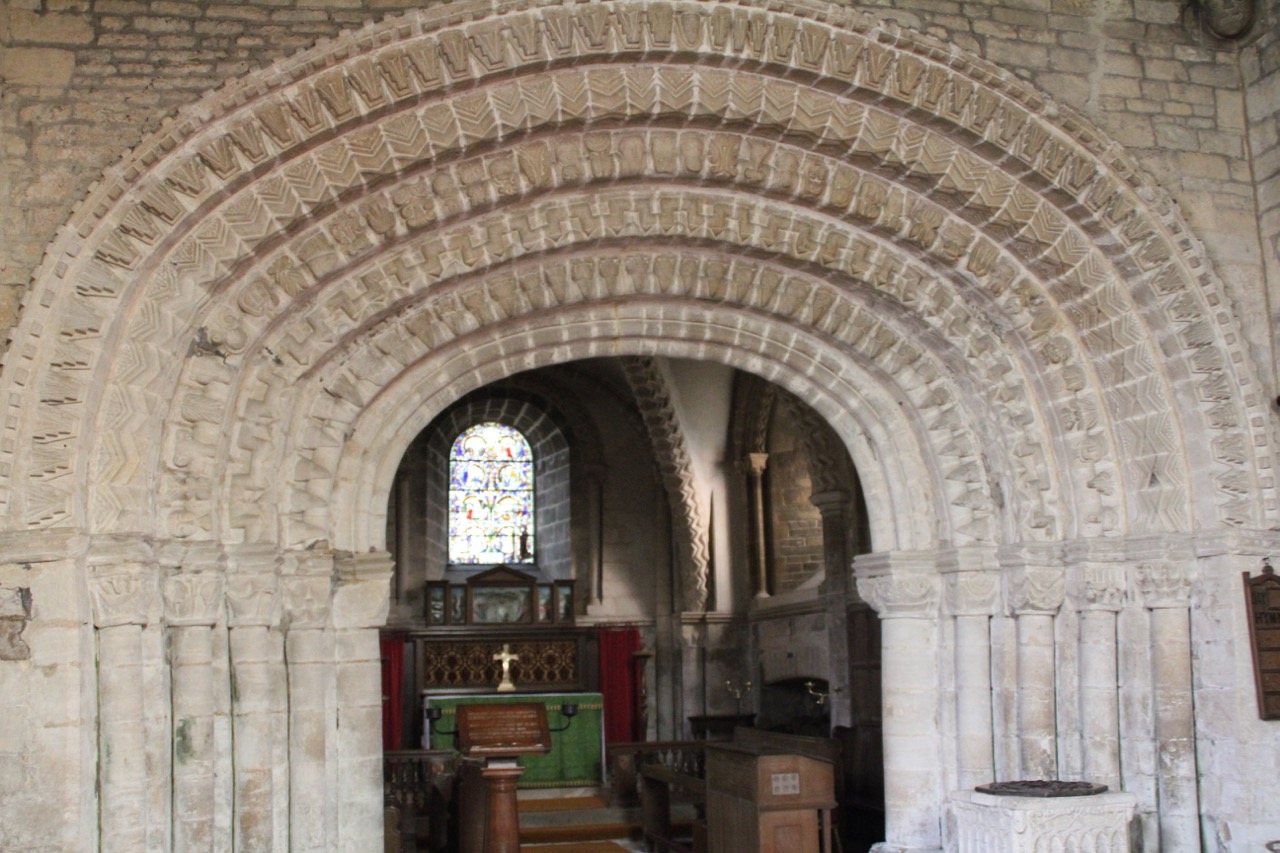

You stroll along the tiny nave
into the chancel - we'll not miss much.
As we leave we make sure you are outside

our farewell photograph sees you seated on the wall
blinking in the cooling sun.