Showing posts with label history. Show all posts

Sunday, June 16, 2019

A good deed and exploring Leicester

Yesterday, a bat, today a bee - huddled on the windowsill looking cold and miserable - so I put out some water and honey, and within five minutes it buzzed and flew away! 

Then we decided to go to Leicester for one or two essentials, and combine it with a visit to Abbey Park. We first discovered the park at the end of April, though we walked a long way round to reach it, via the Great Central Station and cafe, the medieval Trinity Hospital, and Jewry Wall Roman Baths.


 We spent some time sitting drawing - I did a few sketches of this drake.

River Soar


We wandered over to the cafe, only to find it had just closed.

This time we took a more direct route, and reached the cafe in good time. The ice-cream was excellent, and the rain and wind that had appeared on cue as we ate a sandwich earlier stayed away.
The canal on the way to the park


The cardinal looks distinctly odd as he stands guard outside Peppercorn Cafe. 

He died in Leicester - maybe it was a better bet than facing the wrath of Henry VIII. 

Close to the cafe are two gardens, the Lavender Garden and the Cloister Garden.


Wonderful artichokes
The reconstructed wall plan of the abbey is just beyond, and the ruined gatehouse a little further still. It was an enormous place before being destroyed.

 The remains of the gatehouse are a little further on.


It's remarkable how much there is to discover in places we think we know.

Wednesday, April 26, 2017

Calke Abbey and Park

March 28 2017.

This is a place I've intended to visit for some years - I remember a nature ramble one Saturday with our junior school teacher, Winifred Hopper, when I was about eight or nine. At that time the Hall was still occupied and not open to the public.
Then later, my mother told me about an article in the local paper - the last member of the eccentric and rather reclusive Harpur Crewe family had died and the estate had been taken over by the NT, as a sort of time capsule. 


Stables - room for a cart too?

Turnip chopper


The house 

The inside is a clutter of furniture and collections of rocks, of insects, of books, of stuffed animals . . .
A huge rocking horse - and a sedan chair


Gruesome trophies


Bells for the servants


It's just as well most of us don't have the space to keep everything.
The grounds are extensive with a pleasure garde, kitchen garden with orangery, now a fern house. The church is close at hand, reached through an avenue of trees.


The Harpur Crewe graves are adorned with heather mounds.
Daffodils were still in bloom. 

This is a tunnel so that gardener could access the kitchen gardens unseen by any family or guests!
There are glimpse of the lake.
 and the herd of deer.
 In the gardens is a romantic grotto

 More deer close to the house 
 Behind the car park, there is a walk along by some large ponds, where a heron was waiting for fish for quite some time.

I can't resist a good reflection. . .

. . .or two .

Monday, February 27, 2017

Canons Ashby

Visited on Friday 25 Feb 2017. Still considering whether to end my membership over the fox-hunting issue . . . or shall I just write to them in protest??

I forgot to pack my 'big' camera, so all photos here were taken with the phone.

Canons Ashby house was built by John and Elizabeth Dryden around a small farmhouse and the remains of a large medieval priory. John inherited the estate through his wife in the 1550s. Some interesting aspects of the history of the place can be found here.


The gardens, were laid out from 1708-1710 by Edward Dryden, nephew of the poet John Dryden.

The sundial dates from 1710


Add caption
The shepherd boy died when he warned the family of a Royalist attack by blowing his flute. The Drydens were Puritans, and supporters of Cromwell and the Parliamentarians. The statue was made in 1713.

The house from the Lion gates - the lion and sphere was a family crest.

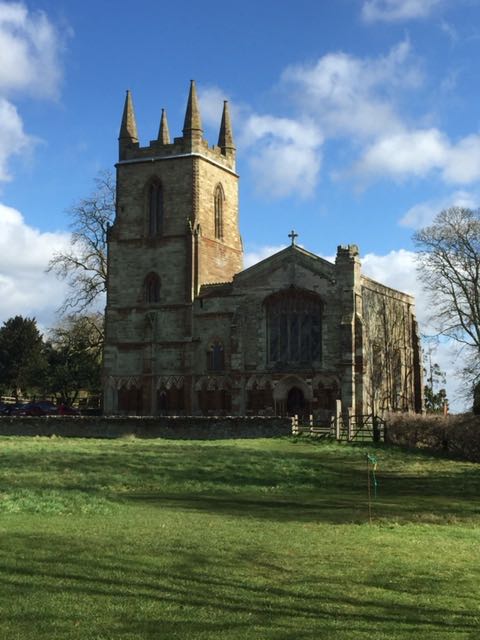
The priory church

Tree shadows

The first lambs I've noticed - and they are huge.

Part of the church

This window was originally in the priory, but was removed following its dissolution.

A heavy Jacobean plasterwork ceiling in the drawing room has had to be supported by metal braces.


The wall painting is an example of late 16th century decoration.


I enjoyed the nursery with its rocking horse
high chair . . .
and puppet theatre.

Small domestic objects intrigue - like this hot water bottle.


I'm told this is "bargeware". Tea for two, anyone?


Figs

The lake at the bottom of the parkland area.


Some rather jolly topiary.


The church and a picnic area.