Showing posts with label church. Show all posts

Saturday, June 15, 2019

a long eared bat

A coffee morning in the local church - we'd gone down to buy a cake, ended up socialising. Suddenly a bat landed on Phil's jumper. It was rescued, looking a bit dazed and replaced in safety.

Wednesday, March 30, 2016

Teigh and its church

Another in my occasional series of interesting churches.

This one is near Oakham, and a church I've intended to visit since walking the Rutland Round in 2012.
From the outside it doesn't look special, but its interior is light and welcoming, and today was filled with the scent of fresh daffodils.

The base of the tower is all that remains of the original 12th or 13th century building. The present church was built in 1782 by the rector, Robert Sherard, Earl of Harborough. The style is "Strawberry Hill Gothic", and the pews face inwards.
Looking toward the pulpit, with the trompe l'oeil window.
toward the altar at the other end of the church.

The two fonts - the smaller one was originally attached to the altar rail. The stone one was carved by a former rector, Anthony Singleton Atcheson.

Teigh is one of the "thankful villages", where all those who served in World War I returned home.

Notable rectors of Teigh

1321 Richard de Folville joined outlawed relations in robbery and murder. He was overpowered by the under-sheriff and his men in Teigh church in 1341, and beheaded in the village street.

1604 Zacharias Jenkinson, a Puritan, refused to bow at the name of Jesus, or stand at the Gospel.

1782 Robert Sherard, later Earl of Harborough, rebuilt the church at his own expense.

1830 Anthony Singleton Atcheson, water colourist and stone carver - he carved the stone font.

1940 Henry Stanley Tibbs was interned on suspicion of being a Nazi sympathiser, but later released as harmless.

Quite a selection for such a small place!

Sunday, March 13, 2016

Grey cat at Tickencote


oh grey cat of Tickencote
are you the guardian of the church
or a volunteer guide?

You watch us as we park the car
and as we lift the latch 
below the lych gate roof


We walk among the gravestones
looking at the carved window arches
and the inscriptions to the dead

the moss-covered ancient mound,
the solid stone statement tombs
and there you are, rubbing against my leg.


A bench for contemplation
faces the old hall's lake
and you leap up, then lightly to a table tomb
the sunlight catching the way your fur
outlines your frame.

When we open the heavy oak door
to admire the chancel arch
and grotesques in ceiling corners
you follow and show us the old cast bell
replaced some eighty years ago.


You stroll along the tiny nave
into the chancel - we'll not miss much.
As we leave we make sure you are outside

our farewell photograph sees you seated on the wall
blinking in the cooling sun.


Wednesday, July 17, 2013

Trinity Chapel near Highoredish

I may have first heard of Trinity Chapel when I found out that my great-great-great-grandfather ( that's my grandmother's great-grandfather) was baptised there in 1792.  Or it may have been when I looked at a map of the area around Highoredish. No matter - I learned that it existed, and had some connection with some of my ancestors. Enough to tempt me to explore, of course.  To reach it you have to walk - it's hidden away in the woods below Highoredish, not far from Mathersgrave. 


I've just searched through my photos - I have four from 1998, before I went digital - in the days of film sent away for developing and printing, and although they were stored in an album, one or two look a little faded. 


The chapel is in a beautiful area - I must revisit and walk nearby. 

According to the Derbyshire Heritage website


a church was recorded on the site in the Domesday survey of 1086 and a 13th century reference in the documents of Darley Abbey mentions what is now merely a footpath to the church as Churchgate Lane. The will of Hugh Revell of Shirland dated 15th May, 1504, states: "I will that the Trinitie Chapel have my chalez, the which is now in their possession, for ever." There is no subsequent record of this chalice, which may have gone missing during the Civil War.
The present Chapel is believed to have been completely rebuilt in the early 1500's, possibly a short time before the Reformation, about 1520-1530. According to tradition, the two bells which the Chapel once possessed were stolen by Oliver Cromwell during the Civil War.

Up to 1758, the Chapel served as a chapel of ease to the parish of Morton, and services were held there four or five times a year.  It was deserted after the investiture of the new Brackenfield Church in 1857.  By 1841, it had already fallen into disuse, partly because of its inaccessibility, and partly because most of the population of Brackenfield now lived around the green, over a mile away.


There is further information on the Brackenfield page of the Amber Churches website.  One interesting item is this:
The ruins of “Trinity Chapel”, the remains of a sixteenth century replacement of the original chapel now hidden in trees, can be reached from a footpath and a village tradition developed of a pilgrimage to the Chapel on Trinity Sunday. This lapsed in recent years but was picked up again in 2010 when a church walk stopped in the chapel for a short service.
So far, I have no knowledge of any paintings or photographs of the chapel before it fell into ruins.  I must thank Charlie Wildgoose of Matlock for putting the idea into my head, in a discussion about one of his photographs.


Sunday, July 14, 2013

Another redundant church - Allexton

I've cycled past Allexton, driven past the village, but never stopped to look. It was only while walking the Leicestershire Round that our route took us into the village and past St Peter's church.  We allow a bit of extra exploration time on most of our walks, so we made a short detour into the church.
Stone lions guard the door, and there are dormer windows in the roof.
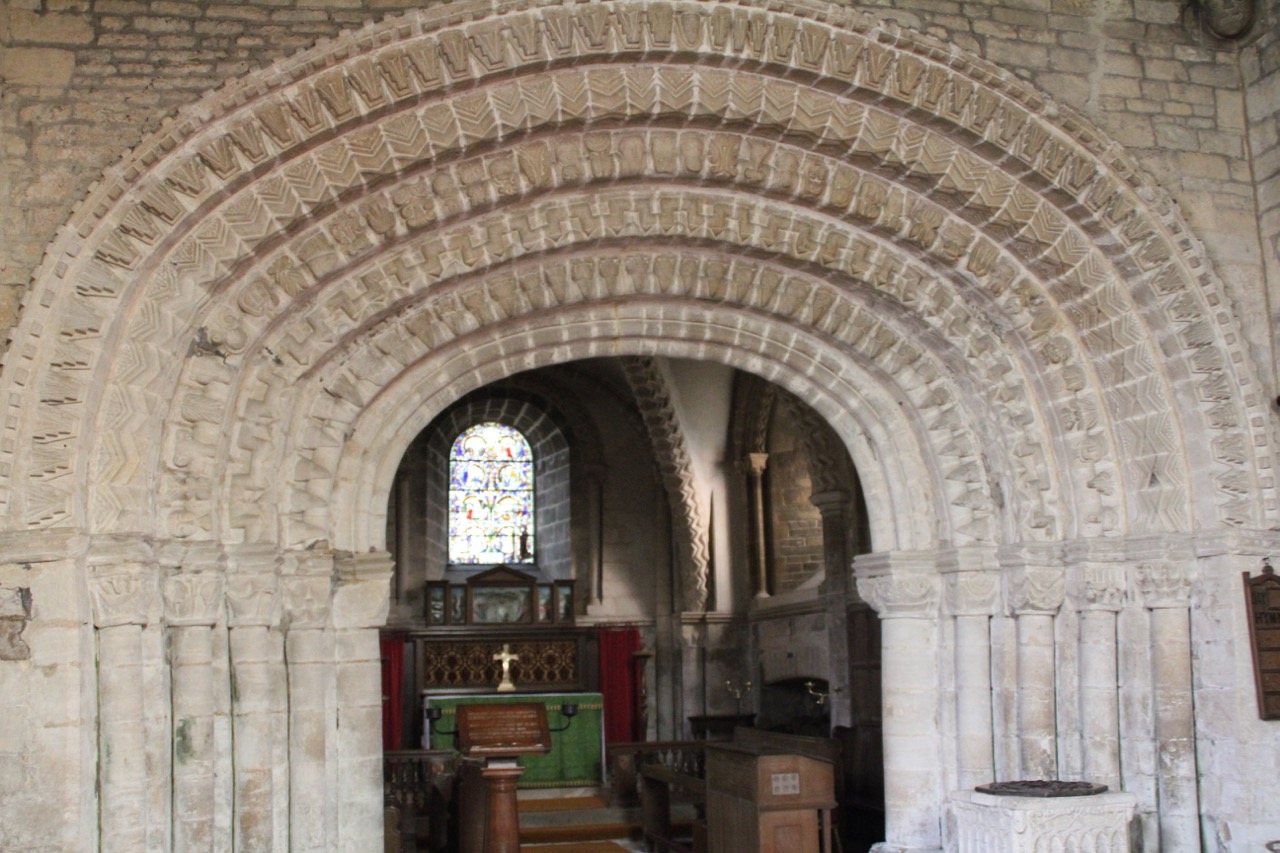
Inside there are two Norman arches, decorated with zigzag carving, similar to those at Tickencote. They were restored in the nineteenth century, but are said to be close to the originals.


There was once a third arch - you can see the beginning of it, with a carved face .
The rest of the arch now forms part of the church tower, and its shape can be seen on the outside wall.

Some medieval stained glass has been re-assembled.  In the church itself there is a naked man climbing a ladder. This may have been part of a doomsday scene.  In the vestry there are two small windows - one has a manticore (top left in the first photo below, and only half visible) - a mythical half man-half beast creature.The other shows twin birds touching at the beak.
 
A close-up of the manticore

The memorial tablets on the back wall inside are dedicated to a vicar, who lived into his seventies, and his wife, who died in childbirth, aged 20. The child survived.
This stone urn stands on the table-top tomb of Thomas Hotchkin, a sugar plantation and slave owner, who died in 1774.

The church was declared redundant in 2000 and placed in the care of The Churches Conservation Trust. Much of the information in this post is from their leaflet.

Friday, July 12, 2013

A redundant church - Withcote Chapel

For a long time, I've loved wandering into and around churches, especially small ones in out of the way villages.  I'm not religious by any stretch of the imagination. It's the weight of generations of history that attracts me to them, as well as the beauty of carvings, wooden and stone, and the windows - whether stained glass, or plain and airy.

The memorial inscriptions - inside or outside -  tell stories, not always obvious, and some make the observer ask questions.  

Withcote Chapel, near Withcote Hall was a private family chapel, probably begun in the 16th century by Catherine and William Smith, and completed after William's death by Catherine and her second husband,  Roger Ratcliffe.  The Palmer family became lords of the manor, and were linked by marriage to the Johnsons. Monuments to all of these are found in the chapel.

The private chapel took on the function of parish church, possibly because the village lost people after the land was enclosed, and the original parish church fell into disuse.  The chapel acquired a font in the 19th century.  There is a small graveyard.

When we were nearby, walking part of the Leicestershire Round, we called in out of curiosity.  I'd seen the place from a distance on a previous walk, and read a bit about it.  We were lucky to find  two volunteers from the Churches Conservation Trust tidying the place up for a rare service which would be held there.  They were very informative and even offered us a cup of tea. 

The stained glass in some of the windows is thought to be part of the original building, designed by the king's glazier, Galyon Hone, and installed in about 1530.  

One interesting plaque mentions a male Palmer who was "primitively religious".  According to one of the volunteers, this probably meant he was high church, or even Roman Catholic, at a period when this was unwise.

It's a lovely building, and its setting is hidden away and delightful, especially on a fine summer's day.

More information about Withcote Chapel.
More about the Churches Conservation Trust.


Sunday, July 07, 2013

Minstead - coffee, stocks and Conan Doyle

We're down south visiting the family.   Being a grandparent, rather than a parent, has its perks - I don't feel obliged to attend the birthday parties Joseph's invited to!  We take ourselves out to Minstead for our essential coffee - and fruit cake.  


It's very much the sort of village you would expect to see on a calendar - a village green with spreading chestnut tree, a circular bench and the old stocks - not fenced like the ones in Gretton, but open for use as a photo-opportunity for kids.  The tea-shop-cum village store and the Trusty Servant pub are both next to the green and outdoor tables are busy on a fine sunny morning.  A group of girls with outsize backpacks arrive and sprawl on the grass for a while.  A young woman leads her small daughter on a pony and pauses by the tree.  A white-haired man in shirt-sleeves calls in for his newspaper. A loud group at the next table discuss acting.  We sit and watch the world turn.

 We know Conan Doyle is buried in Minstead, and we've parked near the church. 
It's one of the oddest-looking churches I've seen - a brick-built hotch-potch of a place, in an idyllic English countryside setting.
The inside is fascinating too - there's a private pew with a fireplace on the north side, a triple decker pulpit and two galleries.  The lower one, seen in the picture was built in the late sixteenth century for the musicians who accompanied the hymns.  An upper one was added in the eighteenth century for the estate workers and their children.
The third notice reads -

ON - FIRST-JANUARY 2000
THIS CONGREGATION UNDERTAKES
on BEHALF of ITSELF
&THOSE WHO FOLLOW
TO CARRY OUT ONE THOUSAND ACTS
FOR THE BENEFIT of OTHERS
THIS PROMISE MADE TODAY
LASTS UNTIL IT IS FULFILLED


Arthur Conan Doyle was originally buried as a non-Christian believer in spiritualism, in Crowborough, Suffolk, where he died.  He was reputedly buried in an upright position in the garden of the large house he owned.  He was reinterred at Minstead later - at the edge of the churchyard.

More information about Conan Doyle and his New Forest connection, the church and Minstead in general can be found on Minstead shop's website.